
When Did Eyeglass Lenses Switch from Glass to Plastic?
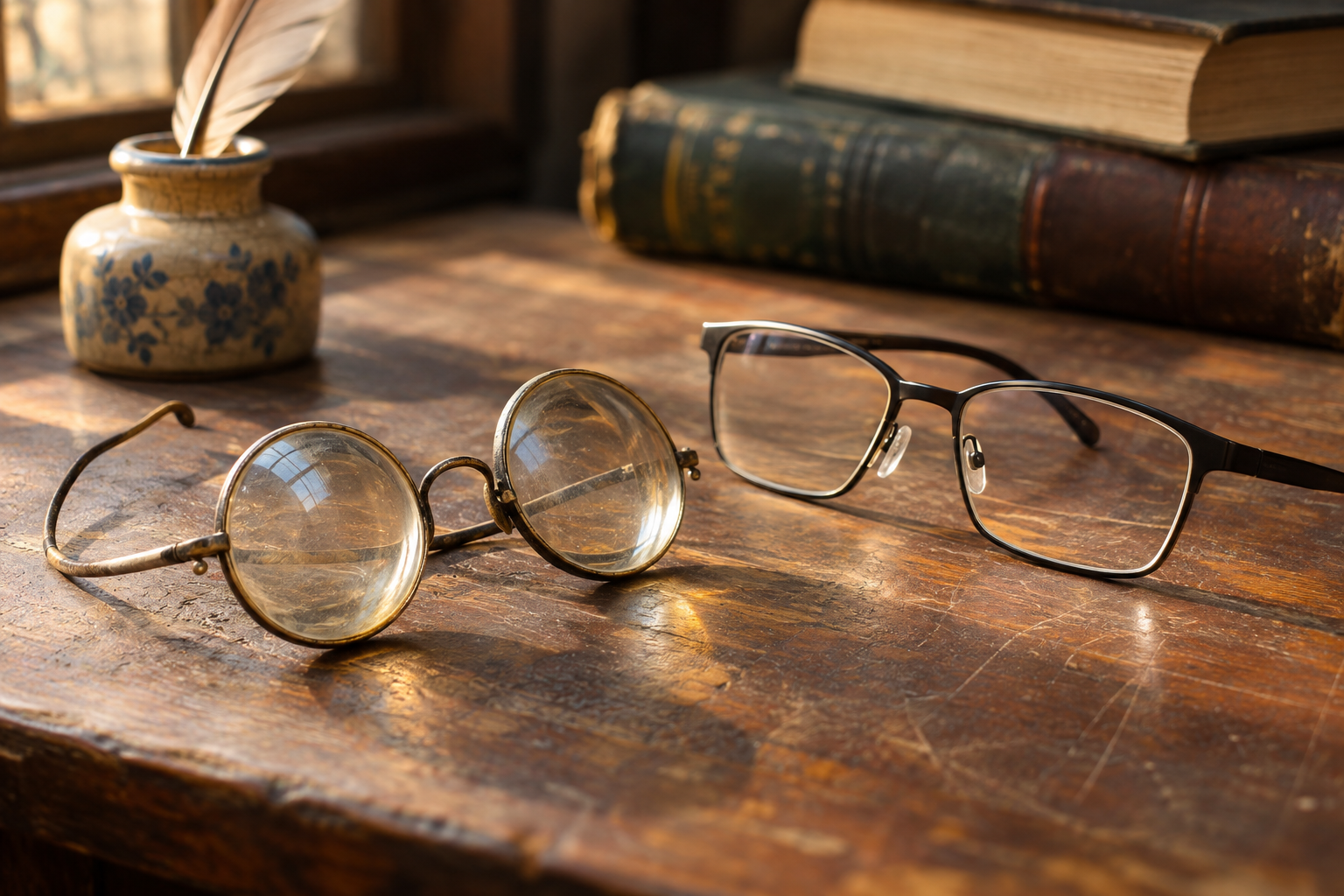
Your glasses slide off the dining table and land on the floor. When you pick them up, the lenses are the first thing you check. Most spectacle lenses today are plastic, but over the long history of glasses, lenses were glass for a very long time. When, and in what order, did that change?
The first plastic spectacle lens to replace glass was the CR-39 lens, which appeared in the United States in 1947. Polycarbonate followed in the late 1950s, and plastic moved into the central place among spectacle lenses.
This article follows the order in which the materials changed, and the impact testing system that arose in the United States along the way. It is not a verdict on which material is better but a walk through history, looking at how each material differed. Refractive index and lens thickness are covered separately in our article on choosing a lens index.
The long age of glass
In an article on spectacles past and present published by the optics society Optica, the optical researcher William Charman writes that by around 1916 the basics of spectacle lens design were already well established. The refractive indices of traditional crown glass and flint glass were 1.52 and 1.62 respectively.
Nor did glass lenses stand still after that. According to the same article, in the mid-1960s Corning introduced photochromic lenses, whose transmittance changes with the intensity of light, and these first photochromic lenses were based on glass.
The first plastic was soft and scratched easily
The first candidate for plastic lenses was acrylic resin (PMMA), a material widely known by names such as Plexiglas or Perspex. According to Charman, it was already available before the Second World War, but it was relatively soft and scratched easily. For spectacle lenses that are cleaned every day, scratching is no small problem.

CR-39, born during the war
Charman identifies the breakthrough as CR-39, a thermosetting plastic developed during the war. Its refractive index of 1.498 was similar to that of crown glass; it scratched less easily than acrylic, stood up well to impact, and had half the density of crown glass. For the same volume, that means roughly half the weight. The first to make spectacle lenses from this material was Armorlite, in 1947.
The Australian College of Optometry museum's record of a SOLA lens in its collection also states that CR-39 was first used for spectacle lenses in 1947 by the Armorlite Lens Company in California, USA, so the two records agree on the year.
The same record goes on to an Australian story. SOLA (Scientific Optical Laboratories Australia), founded in 1960, grew out of the technology of Donald Schultz, who had long been interested in making spectacle lenses from CR-39, and became an international company making CR-39 lenses. The lens envelope held by the museum was made in Taiwan in the 1990s and was old stock from the college's dispensary.
In search of greater impact resistance
Polycarbonate's starting point was Germany. According to a record of 70 years of polycarbonate from the materials company Covestro, the material was developed by Hermann Schnell, who had moved in 1953 to the research laboratory at what was then Bayer's Krefeld-Uerdingen plant, and the patent certificate is dated 16 October 1953. The material was also used in the helmet visor of the US astronaut Edward H. White, who made a spacewalk in 1965.
As for when it came into spectacle lenses, Charman points to the late 1950s. Amid demand for greater impact resistance, polycarbonate lenses appeared; they were first used in safety glasses and, as their optical quality improved, spread to spectacle lenses of all powers.
Each material has its own character. In the figures Charman gives, polycarbonate's refractive index of 1.586 is slightly higher than that of crown glass, but its Abbe number, which relates to colour fringing, is 30, lower than CR-39's 58. Charman also wrote that it is not particularly scratch-resistant, so its surface is usually given a hard coating. No material comes out ahead on every count.
Early 1970s: steel balls start to drop
In the United States, a test arose that lenses had to pass whatever their material. The US Food and Drug Administration (FDA)'s guidance on impact-resistant lenses quotes the wording of federal regulation 21 CFR 801.410 to describe the test. A steel ball 5/8 inch (about 1.6 centimetres) in diameter and weighing about 0.56 ounce (about 16 grams) is dropped from a height of 50 inches (about 127 centimetres) onto the centre of the upper surface of the lens, and the lens passes if it does not break.
According to the guidance, in the United States glasses and sunglasses must use lenses that withstand this test. The only exception is when a doctor or optometrist judges such lenses unsuitable for that patient, directs the use of other lenses in writing and informs the patient. Glass, plastic or laminated glass, the method is free, but the test must be passed. There is also a difference: prescription glass lenses are each tested individually, while plastic lenses may be tested using a statistically significant sample from each production batch.
When did this begin? A 2016 fact sheet from Prevent Blindness, a US eye health organization, says the FDA's minimum impact standard was established in 1971, and cites a 1985 book estimating that before then there were about 120,000 lens-related injuries a year. Another passage in the same fact sheet, however, says it dates from 1970, so the starting year differs even within a single document.

Passing the test does not make a lens “shatterproof”
The FDA guidance addresses a few common misconceptions. Passing the impact test does not mean a lens cannot break, so the word “shatterproof” should not be used on the strength of the test result alone. Nor, it says, is a lens automatically impact-resistant just because it is made of plastic.
A lens's strength is also tied to the condition of its surface and edges: the more numerous and deeper the scratches, and the rougher the edge finish, the weaker it becomes, according to the guidance. It advises against using ordinary glasses and sunglasses as protective equipment for sport, and recommends goggles that meet the safety standard for the sport in question. Protecting your eyes when playing sport with contact lenses in is covered in our article on sport and protective eyewear.
What lighter lenses left behind
Spectacle lens materials widened from glass to CR-39, and then to polycarbonate and plastics with higher refractive indices. Charman sums up that, thanks to their many advantages, plastic lenses took the dominant position in the spectacle market. Meanwhile, the United States set up a test that drops the same steel ball from the same height without asking what the material is.
Next time you clean your glasses, tilt the lenses under a light and look for fine scratches. Whatever the material, the condition of a surface you clean every day is also part of the lens's story.