
1.60, 1.67, 1.74: Does a Higher Number Mean a Better Eyeglass Lens?
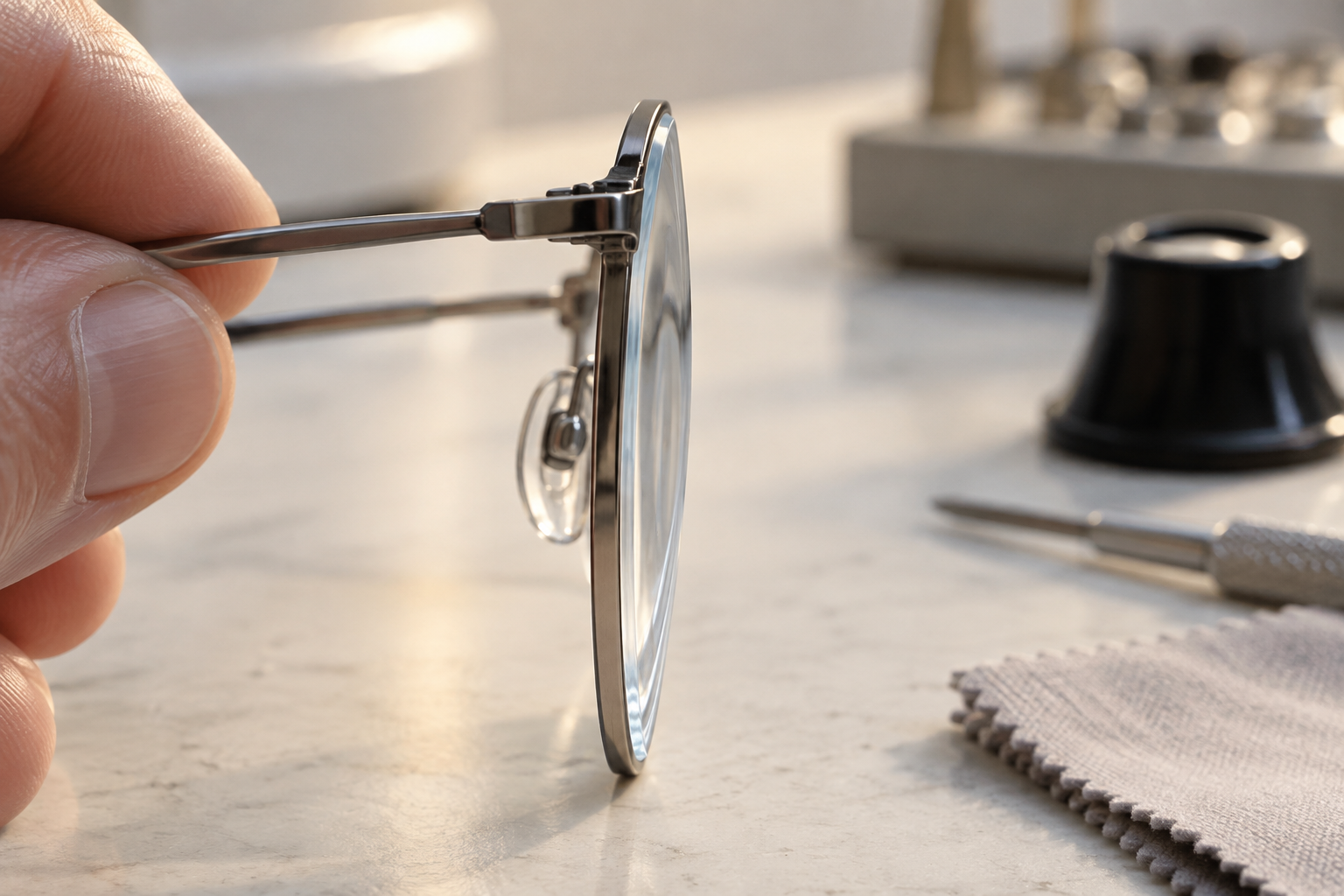
Take off your glasses and look at them from the side, and the edge of the lens is sometimes thicker than you expected. Look up anything about lenses and numbers such as 1.60, 1.67 and 1.74 are sure to turn up. As with test scores, does a higher number mean a better lens?
These numbers are the refractive index, which shows how much a lens material bends light. They are not a quality score but a figure for how little material is needed to make the same power.
Other properties change as the number goes up, too. This article reads a manufacturer's thickness comparisons together with their conditions, and looks at the Abbe number, another figure that goes hand in hand with refractive index.
A number for the power to bend light
ZEISS's guide to lens materials explains that this number is the refractive index of the lens material and shows how well the material bends light. It also explains that the higher the number, the less material is needed to do the same job. The same page lists 1.50, 1.53, 1.59, 1.60, 1.67 and 1.74 in order, and states that the refractive index of standard plastic lenses is 1.5.
The entries for 1.53 and 1.59 carry the material names Trivex and polycarbonate respectively. The number is a property of the material, not a grade that bundles in the lens design or coatings as well.
The conditions attached to “up to 40%”
The same guide states that a 1.6 material can reduce lens thickness and weight by up to 20% for the same prescription, and that high-index materials such as 1.67 or 1.74 can be up to 40% thinner and lighter than standard-index lenses of the same prescription. The same company's introduction to high-index lenses also describes them as up to 40% thinner than conventional lenses.
When reading these figures, three conditions need to be kept in view: the comparison is with a standard 1.5 lens, it assumes the same prescription, and it says “up to”. In this sentence 1.67 and 1.74 are grouped under the same “up to 40%”, so the difference between the two cannot be told from this sentence alone. While saying that refractive index affects thickness and weight, the guide also adds the qualifier that this applies especially when the prescription is strong.

Frame size and shape change thickness
Even with the same material, the thickness of the finished lens depends on the frame. ZEISS's guide to thickness optimization explains that a lens can often be made thinner if, instead of being made round like a cylinder, it is calculated to match the shape of the chosen frame. The factors it lists are the shape and size of the lens, how the frame holds the lens (whether the frame goes all the way round the lens, halfway round, or not at all), data on where the lens centres should be, the lens material, the power and prism, and the lens type (single vision, bifocal, trifocal or progressive).
Material is one of six items on this list. That is why it is hard to compare a 1.74 lens in a large frame with a 1.67 lens in a small frame on the numbers alone.
Along with thickness, the size of the eyes seen through the lens also changes. The introduction to high-index lenses mentioned above explains that thick plus lenses make the eyes of farsighted people look bigger, while minus lenses make the eyes of nearsighted people look smaller and the outline of the face look narrower. It also states that lenses with an aspheric surface are thinner and flatter while giving the same correction.
Another number beside the index: the Abbe number
The number to look at alongside a rising refractive index is the Abbe number. According to Mo Jalie's article on lens form, published by the UK opticians' association ABDO, the refractive index of a lens material varies slightly with the wavelength of light, that is, with its colour. This property is called dispersion, and the Abbe number is the value expressed as the reciprocal of dispersion. The higher the Abbe number, the smaller the difference between colours.
In the material line-up of Japan's Mitsui Chemicals, which makes raw materials for lenses, the Abbe numbers are 39 and 41 for the 1.60 materials, 31 for both 1.67 materials and 32 for the 1.74 material. Jalie's article gives about 60 for materials with a refractive index around 1.5 (crown glass and CR-39). There is a visible trend of the Abbe number falling as the refractive index rises, but in this list 1.74 is 1 higher than 1.67, so the numbers do not always move in one direction. As the two sources are different, they are better read as a trend than compared down to a single unit.
Colour fringing shows at the edge of the lens
Differences in Abbe number become visible at the edge of the lens. Jalie's article calls this transverse chromatic aberration and explains that it makes coloured fringes appear around objects with strong contrast. When contrast is low, it shows up not as coloured fringes but as peripheral blur with slightly reduced vision, and the article notes that people often describe it as “fine when I look through the middle, but blurry when I look through the edge”.
According to the article, its size is close to the prism effect at that point of the lens divided by the Abbe number. Below 0.1 prism dioptres, discomfort is considered rare; a material with an Abbe number of about 60 reaches this value only about 15 mm from the centre of a +4.00 lens, while a material with an Abbe number of around 40 reaches it at 10 mm. This means that, even at the same power, colour fringing can begin closer to the centre when the Abbe number is lower.

Thinness, clarity and weight move separately
To sum up, refractive index has a bearing on thickness, the Abbe number on colour fringing at the edges, and the size and shape of the frame and the centre position on the finished thickness. Weight includes not only the lenses but also the frame itself. No single number can rank all of these in one line.
That is why lenses and frames make more sense looked at together than one at a time. Which combination suits you depends on your prescription, the condition of your eyes and the distances you mostly look at, so it is best to check with an optician or optometrist. Coatings on the lens surface are another story, covered in Why Do Eyeglass Lenses Reflect Green in Photos?.
Next time you look at your glasses from the side
The figures 1.60, 1.67 and 1.74 are not lens grades but the power of a material to bend light. The higher the number, the less material is needed for the same power, but the thickness differences manufacturers cite come with conditions for comparison, and there is also the Abbe number, which tends to fall as refractive index rises.
Next time you are wearing your glasses and look through the edge of a lens at something with sharp contrast, such as a bright window frame, check whether a faint coloured fringe appears along the boundary. The other number that goes hand in hand with refractive index is right there.