
Why Shouldn't Used Contact Lenses Go Down the Toilet?
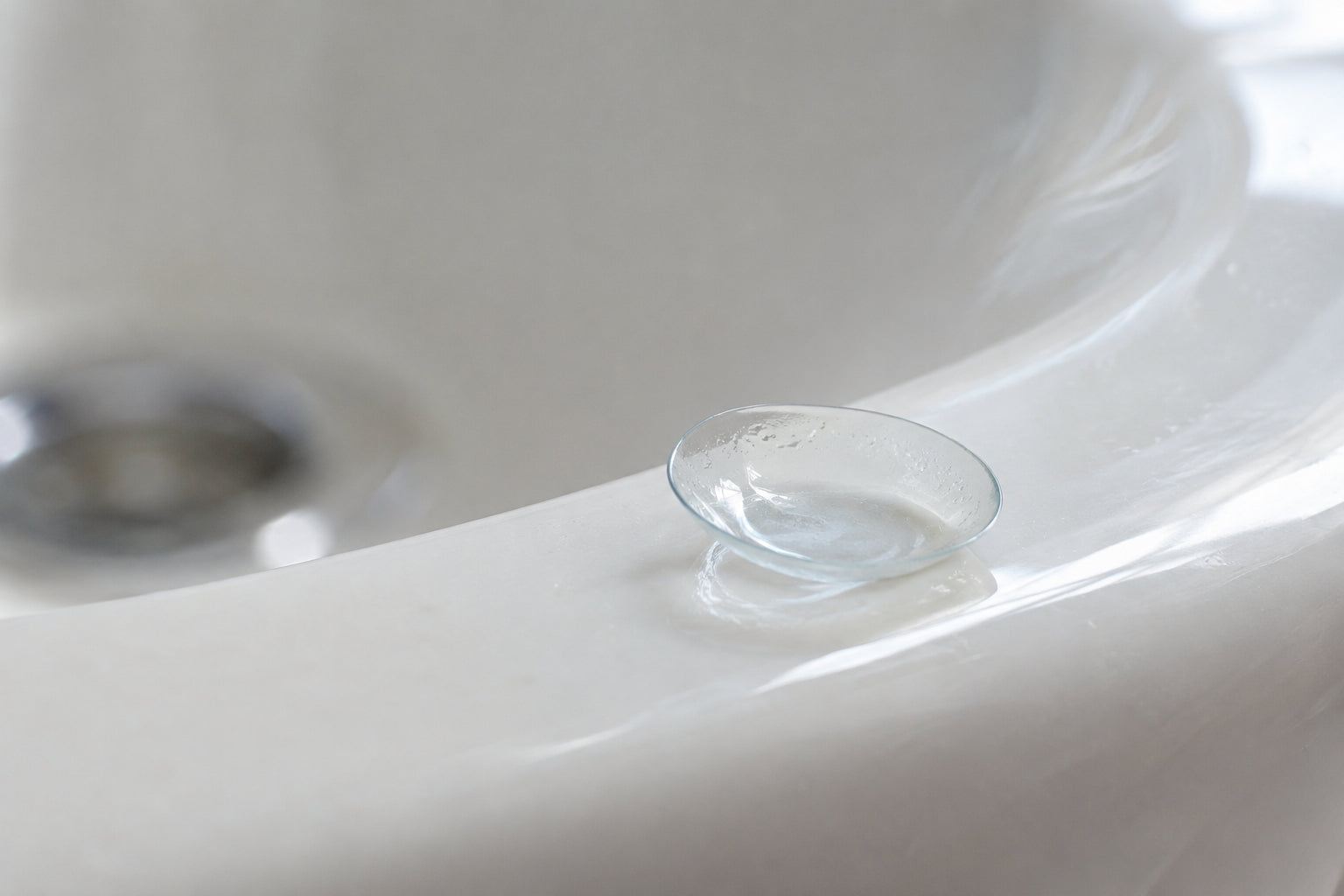
Late at night at the bathroom sink, you take out the lenses you have worn all day. The thin film on your fingertip keeps clinging to your finger even on the short trip to the bin, and if you flick it into the drain, it vanishes with the water in an instant. Gone from sight, it feels like the end of the matter. But is it?
Research has found that lenses that go down the drain do not dissolve away, but remain in sewage sludge after being broken into small pieces at wastewater treatment plants.
This article follows how a university research team in the United States traced where lenses end up, and sets out how professional bodies advise disposing of them. How the habit of switching to fresh lenses every day took hold is covered in How Throwing Away a Fresh Lens Every Day Became a Worldwide Habit.
A question from a researcher who had long worn lenses
According to Arizona State University's 2018 news release, the research began with a question from Professor Rolf Halden. Halden, who had worn glasses and contact lenses for most of the years since adulthood, asked whether anyone had studied what happens to plastic lenses once they reach the end of their useful life. Halden is a researcher who leads the Center for Environmental Health Engineering at the university's Biodesign Institute.
The first results were presented on 19 August 2018 at a meeting of the American Chemical Society in Boston. The presentation was given by doctoral researcher Charles Rolsky. The release stated that around 45 million people in the United States alone wear contact lenses.
One in five, down the drain
The team began by asking lens wearers in the United States where they throw away used lenses. The 2018 presentation found that 15–20% of wearers dispose of them in the sink or toilet. The same team's paper, published in 2020 in the journal Environmental Science & Technology, put this figure at 21±0.8%, based on responses from 416 people. That is roughly one in five.
There was also a reason for looking at lenses in particular. The university release explains that lenses are a distinctive kind of plastic, made by combining materials such as polymethyl methacrylate, silicones and fluoropolymers, and that they are not something environmental surveys commonly examine.

What happens at the treatment plant
Lenses that go down the drain usually reach a wastewater treatment plant. There, microorganisms break down pollutants in the water. The team exposed five lens materials to microorganisms taken from a treatment plant, under conditions with and without oxygen, for various lengths of time.
The two sources describe the results slightly differently. The 2018 release says the lenses withstood the treatment process for a long time, but that the microbes altered their surfaces and weakened the bonds in the polymers. The abstract of the 2020 paper states that biological treatment did not noticeably reduce the mass of the plastic, and that changes in the polymer structure were very limited. The two differ on how much weight to give the surface changes, but they agree that the lenses do not break down and disappear.
Lenses that do not disappear become fragments. According to the paper's abstract, the lenses broke into pieces during treatment and accumulated in the sewage sludge. The release stated that roughly one pair of lenses is found for every 0.9 kg (2 pounds) of sludge.
The sludge goes back onto the land
The story does not end at the treatment plant. The paper's abstract states that the microplastics that accumulate in sludge end up being spread on farmland in the United States. The release also explains that spreading sewage sludge on land is common, and that water running off through that soil can pollute streams and rivers. It adds, however, that the study did not directly observe lens fragments entering rivers or the sea.
Why are microplastics a concern? The release explains that aquatic creatures mistake microplastics for food, so that indigestible plastic enters long food chains.
A paper published in 2023 in the journal Molecules by a team at Pusan National University pointed to a different problem. Discarded lenses are often folded or stuck together in layers, and in a commonly used infrared analysis, multi-layered fragments overloaded the signal and were hard to identify as lens material. Fragments whose properties had changed through acid treatment could also be classified as other substances. In other words, simply counting lens fragments in the environment is trickier than it might seem.
The numbers differ from source to source
So how many go down the drain each year? Here the figures vary from source to source. The 2018 university release estimated that 1.8 to 3.36 billion lenses, or about 20–23 tonnes by weight, are flushed into the sewers every year in the United States. A document from the American Optometric Association (AOA) published the same year cited the same university's announcement as its source, yet gave a figure of 6 to 10 tonnes a year. The 2020 paper calculated the dry weight of lenses at 44,000±1,700 kg a year, or about 44 tonnes.
The sources do not explain why the three figures diverge, so it is hard to say for certain which is right. What they have in common is that all three are in tonnes. The Pusan National University paper gives the dry weight of a single lens as about 0.0167 g; on that basis, one tonne comes to about 60 million lenses.

So where should they go?
The suggestion from Professor Halden, who led the research, was simple: put lenses in the bin with other solid waste, and have manufacturers print disposal instructions on the packaging. In the same document, the AOA's Contact Lens and Cornea Section also urged optometrists to tell patients not to flush lenses down the sink or toilet.
There is guidance on packaging too. The document states that most individual lens packages are stamped with recycling number 5, and that they must be clean plastic with the foil top removed. It says paper boxes and solution bottles may be recyclable through local recycling collections, and advises checking the rules where you live. It also mentions a recycling programme (TerraCycle) that accepts used lenses together with their packaging, and notes that optical practices can serve as collection points. This is US guidance; whether such programmes exist, and how waste must be sorted, varies by country and region.
The reality still seems a long way off. The 2020 paper calculated that only 0.04% of the waste generated by wearing lenses is recycled. Why the packaging is so much bigger than the lenses is covered separately in our article on lens packaging waste.
One more moment at the drain
Lenses are so small and thin that they leave your hand before you have time to think about where to put them. The path the research team followed shows that this brief moment extends all the way to treatment plants and farmland.
Next time you empty a box of lenses, turn an empty individual package over. If there is a small number 5 stamped somewhere on the plastic, it is a sign that the little plastic home your lens came in is also something that needs a place to go.