
Why Are Sunglass Lenses So Often Grey, Brown or Green?
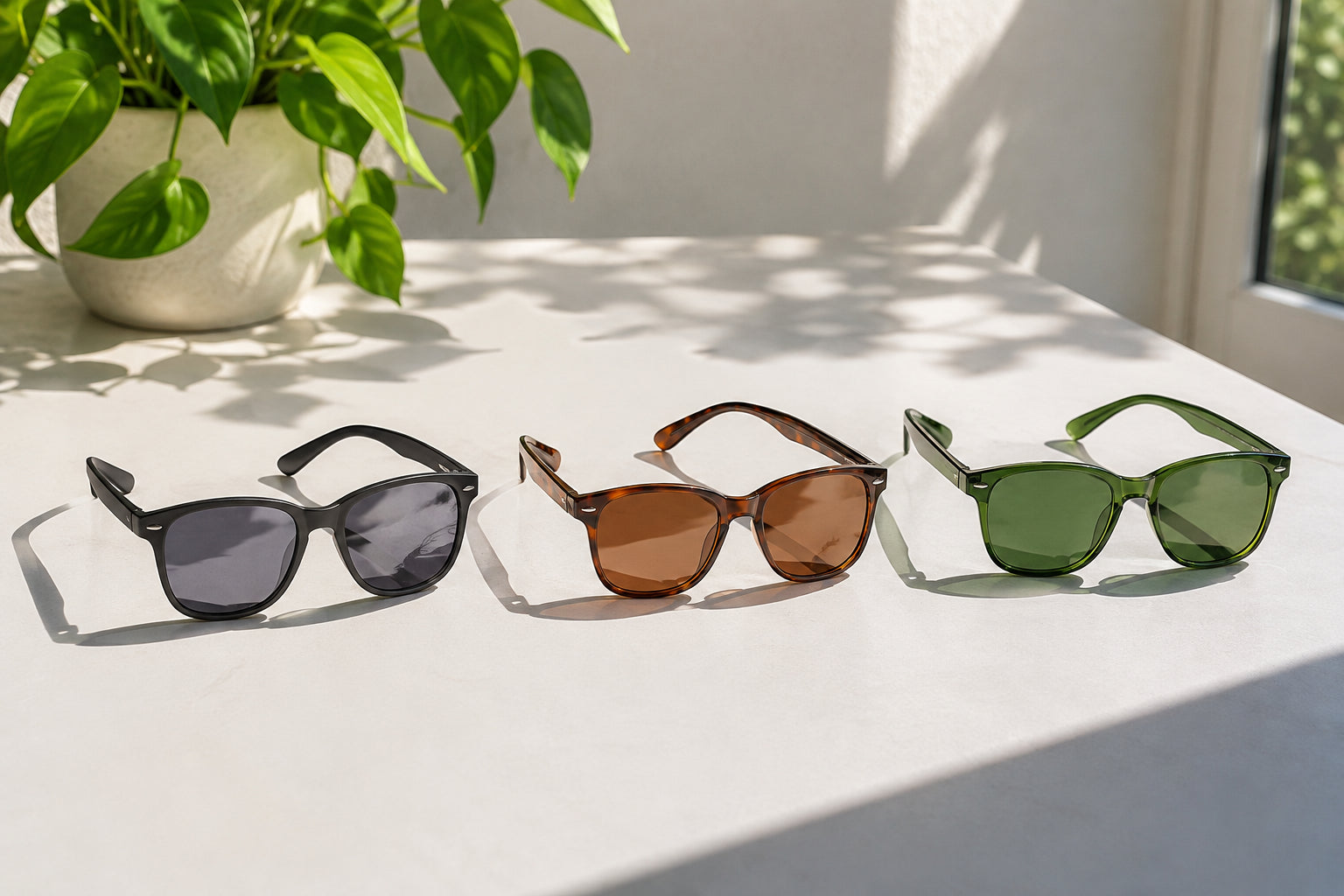
Try on pair after pair in a sunglasses shop and the same street looks different depending on the lens colour. Through grey lenses the scene darkens quite a lot; through brown lenses it feels a little brighter. The lens colours you see most often also sit somewhere around grey, brown and green. Out of all the colours there are, why these?
Lens colour decides which light is filtered out and by how much, changing even the way colours look, and sunglasses for driving must also meet a standard requiring that traffic signal colours can still be recognized.
This article looks in turn at how lens colour affects colour discrimination and contrast, the traffic signal requirements in US and Australian standards, and research on yellow lenses for night driving. UV protection labels are a separate matter from lens colour and are covered in our article on UV labels.
Green spectacles on Christmas Eve 1666
Tinted lenses are older than you might think. In an article on the history of spectacles published by the optics society Optica, the optical researcher William Charman notes that lenses of various colours and transmittances had existed for a long time, and quotes one scene. On Christmas Eve 1666, the English diarist Samuel Pepys recorded in the diary the purchase of a pair of green spectacles, to see whether they would help the diarist's eyes.
So even 360 years ago, someone hoped that green lenses would help their eyes. Whether those spectacles really helped, however, this single line cannot tell us.
Grey, brown and green filter light differently
A 2024 guide to buying sunglasses by optometry researchers at the University of Santiago de Compostela in Spain explains that lens colour does not change the level of protection, but it can affect how contrast and brightness are perceived. This is because each colour filters out different wavelengths of light.
According to the article, grey lenses filter all wavelengths of light. Brown and green absorb light in different ways, so the world tends to look brighter through brown lenses, quite dark through grey lenses, and more natural through green lenses. The impression of the same scene changes depending on which colours of light are left.
The same article defines contrast sensitivity as the ability to distinguish an object from its background, and gives the example that black letters on a grey background are harder to make out than black letters on a white background.

A colour test through brown lenses
Some research has measured directly how lens colour affects colour discrimination. A 2009 study from Japan had young women take the 100 Hue test, which assesses colour discrimination, at a brightness of about 5,000 lux, wearing smoke, blue or brown lenses, or no sunglasses.
When the four conditions were compared by overall score, there was no significant difference. But comparing brown lenses with the naked eye alone, there were differences in 9 of the 100 colours. In the purple-blue range, errors were smaller with brown lenses, while in the red-purple and blue-green ranges they were actually larger.
This suggests that, rather than improving or worsening colour discrimination across the board, lens colour may act differently depending on the colour range. However, it is a single study of young women only, so it is hard to extend it to all brown lenses and all people.
Traffic signal colours must be recognizable
When you drive, colour discrimination becomes a safety issue. The US Food and Drug Administration (FDA)'s 1998 guidance on non-prescription sunglasses explains that the traffic signal recognition clause of the US standard ANSI Z80.3 was written with people with colour vision deficiency in mind. For that reason, it adds, some of the requirements may be overly strict for people with normal colour vision. The guidance states that about 8% of men and less than 3% of women have some form of colour vision deficiency.
The same guidance advises that sunglasses sold for driving must pass the requirements of section 4.5 of the international standard ISO 14889 or section 4.6.3 of ANSI Z80.3-1996, and that if they meet neither, they should carry the label “CAUTION: not for use while driving”. Lens colour is a matter of taste, and at the same time something that is tested and labelled.
Lenses that filter out a lot of blue light, and national standards
The Australian Competition and Consumer Commission (ACCC)'s 2016 review of the sunglasses standard deals with this issue in more detail. It explains that filtering out blue light can reduce the ability of people with colour vision deficiency to recognize road signals, which can lead to slower or wrong responses, and that dim conditions and lenses that let almost no blue light through affect colour discrimination, especially with old incandescent traffic signals.
The document also compares the standards of the time country by country. It wrote that the ISO standard's requirements on blocking blue light were lower than those of the Australia/New Zealand standard AS/NZS 1067:2016, and that the US ANSI standard was looser still, so colours unsuitable for driving could result, yet there was no requirement to label them as such. In the United States, the FDA guidance mentioned above takes the form of recommending a label. The rates of colour vision deficiency in Australia given in the document are about 8% of men and 0.4% of women; the figure for women differs from the one in the FDA guidance.

What about yellow lenses for night driving?
Yellow lenses for night-time use have been sold with advertising claiming that they reduce glare and eye strain and improve night vision. A 2019 EyeNet article from the American Academy of Ophthalmology (AAO) presents a study that tested this claim. In it, 22 adults with normal vision drove at night in a driving simulator that recreated the glare of oncoming headlights, wearing in turn three types of yellow-lens glasses available on the market and glasses with clear lenses. The time it took to spot pedestrians walking along or crossing the road was measured, and in no condition was there a significant difference between the yellow and clear lenses.
The researchers questioned the idea of recommending these lenses to people who find night vision difficult. It was a small study carried out in a simulator, but the FDA's 1998 guidance also gives, as an example, wording stating that tinted glasses are not recommended for night driving.
Comparing traffic lights with and without lenses
In the sources seen here, grey, brown and green are treated as colours that adjust the sense of brightness and contrast rather than changing colours wholesale. For driving, traffic signal standards are added on top of this, and wording against using tinted lenses for night driving appears as an example in the FDA guidance. If colours look different from usual or night vision is uncomfortable, it is best to check with an ophthalmologist or optometrist. Polarization, yet another property, can be found in our article on polarized sunglasses.
Next time you stand at a pedestrian crossing wearing sunglasses, compare how the red and green of the traffic light look with how they look to the naked eye. What a lens colour keeps and what it filters out lies in that small difference.