
Why Do Lens Powers Come in Steps of 0.25?
You sit in the eye test chair and the machine in front of you clicks as it changes lenses. “Is it clearer with number one, or number two?” After a few answers, a number such as -2.75 or -3.00 is written on your prescription. You rarely see -2.80 or -2.90. The eye is a smooth, continuous organ, so why do the numbers move like a staircase, 0.25 at a time?
For nearly 150 years, the lenses used in eye tests have not been divided more finely than 0.25 dioptres, and prescriptions and lens production have followed that scale.
This article looks at how the dioptre, the unit of lens power, came about, where the 0.25 step began, and, using manufacturers' specification sheets, how contact lenses switch to 0.50 steps at high powers. How to read each item on a prescription is set out in our article on reading a prescription.
When powers were written in inches
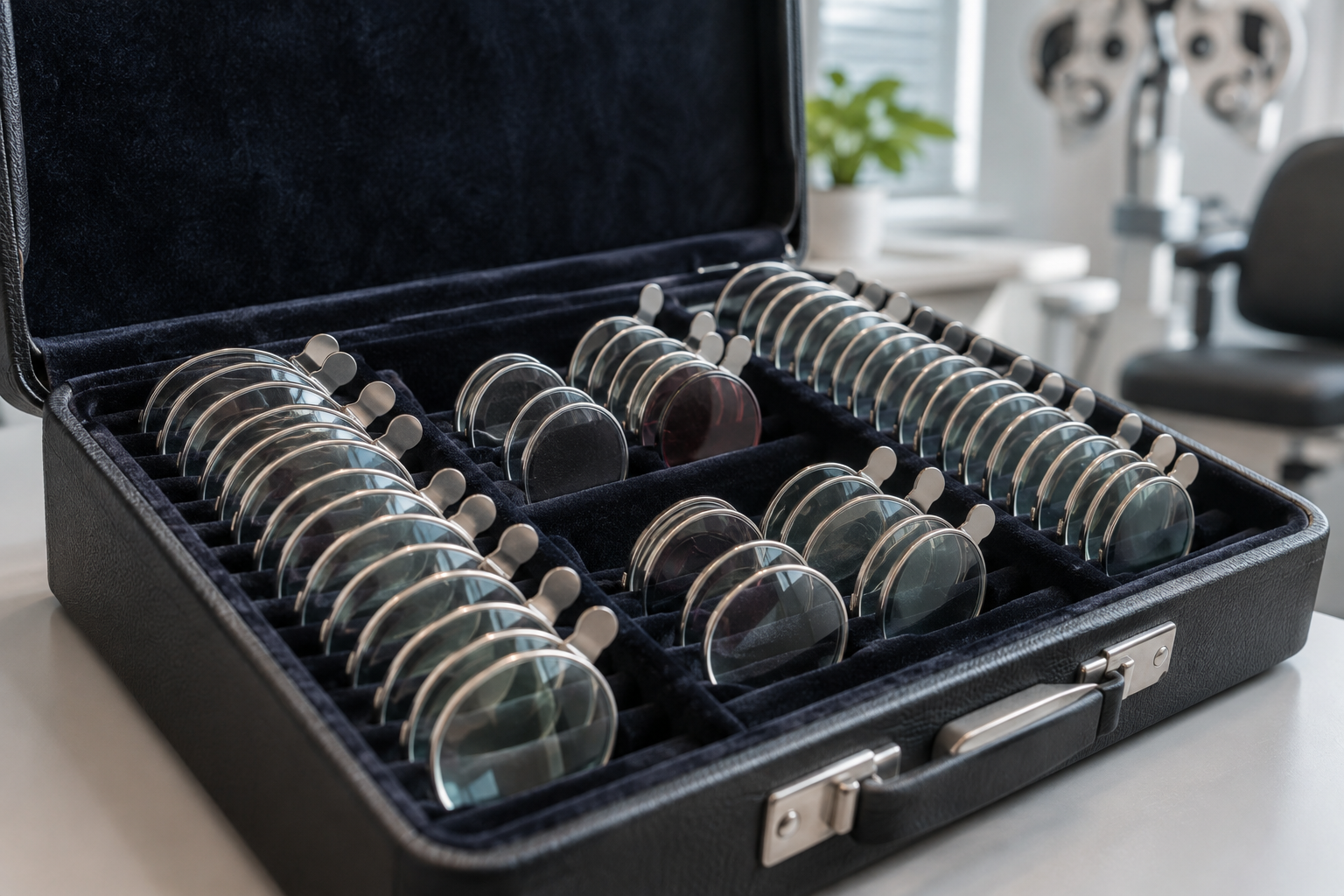
The optometry museum of the Australian College of Optometry holds a trial lens set from around 1880. Inside a black leatherette case, between the rows of paired lenses, runs a strip made to imitate ivory, engraved with the powers. What catches the eye is that there are two units: one is the dioptre, the other the inch.
The museum record briefly notes why the inch was unsatisfactory: Britain, Prussia and France each called a different length an inch. Lenses engraved with the same number could mean different things depending on which country's ruler had been used to measure them. Two units side by side in one case show a period of transition from the old way to the new.
A unit that takes 1 metre as 1
The new unit was proposed by the French ophthalmologist Ferdinand Monoyer. According to the same museum record, the dioptre was proposed in 1872, officially adopted at a medical congress in Brussels, Belgium, in 1874, and quickly came into use.
A dioptre is the reciprocal of the focal length measured in metres. OpenStax College Physics, an open textbook from Rice University in the United States, writes the power of a lens as 1/f and gives 1 dioptre as 1/m. A lens with a focal length of 1 metre has a power of 1 dioptre; one with a focal length of 50 centimetres, 2 dioptres. 0.25 dioptres is a very weak lens, with a focal length of fully 4 metres.
The larger the number, the shorter the focal length, which means a lens that bends light more strongly. A minus sign in front indicates a power for short-sightedness, and a plus sign a power for long-sightedness.

The weakest lens in the case was 0.25
Let us go back to the case from around 1880. According to the museum record, the set originally held 24 pairs of plus lenses and 24 pairs of minus lenses, with powers from 0.25D to 7.00D. Most of the lenses are now gone, but the record that the weakest was 0.25D remains.
Test equipment changed greatly after that. According to an article on refraction written in 2020 by researchers at Essilor, which makes spectacle lenses and optometric instruments, the trial frame, in use since the 18th century, gave way around 1930 to the manual phoropter (an instrument for switching lenses during an eye test), and later to the automated phoropter. Yet the step between the lenses shown to the patient never became smaller than 0.25D, the article points out; it has been the same step for the past 150 years.
This step also appears throughout the traditional test sequence. The same article describes deliberately adding plus power to blur vision and then reducing it 0.25D at a time to find the sphere power, and adjusting the sphere power by +0.25D for every -0.50D change in the astigmatism power.
Machines that measure more finely have appeared
If 0.25 were the limit that every eye could distinguish, there would be no reason to divide it more finely. Yet the same article introduces an optical device that changes the sphere power from -20.00D to +20.00D in steps of 0.01D.
The interesting part is the explanation that the step is used differently for different people. During the test, the device looks at how sensitively the person notices changes in power, narrowing the step for those who are sensitive and widening it for those who are not. In other words, the 0.25 step may not be a single answer that fits everyone.
However, this is a company describing its own technology, so it does not go as far as showing what difference a more finely measured prescription makes in daily life. The basic step for prescriptions is still 0.25. Johnson & Johnson's ACUVUE guide to lens power likewise explains that prescriptions are usually written in 0.25D steps, and that this matches the way most contact lenses are made.
Where the steps widen on contact lens specification sheets
Contact lens specification sheets show another picture. In Johnson & Johnson's 2026 Middle East specification sheet, one daily spherical lens runs in 0.25D steps from -0.50D to -6.00D, then in 0.50D steps from -6.50D to -12.00D. On the plus side, too, it is 0.25D up to +6.00D and 0.50D beyond that, up to +8.00D. The two-weekly lens in the same sheet follows the same pattern.
Other companies' sheets are similar. In CooperVision's 2026 US product reference guide, several products carry a note that the steps are 0.50D beyond ±6.00D. Among them, one daily lens widens its steps once it passes +5.00D on the plus side, while a multifocal lens in the same guide keeps 0.25D steps down to -10.00D and switches to 0.50D only beyond that.
Divide the range between -6.00D and -12.00D into 0.25D steps and there are 24 powers to choose from; divide it into 0.50D steps and there are 12.

What the specification sheets do not say
These tables show where the steps widen, but they do not say why. That the boundary differs from product to product shows it is not a single rule applied equally to every lens. The tables seen here are the Middle East and US editions, so line-ups in other countries need to be checked separately.
It is also worth remembering that at high powers, the numbers on a glasses prescription do not carry over unchanged to contact lens power. The reason is covered in why glasses and contact lens prescriptions differ. If the numbers on your prescription and the numbers on the box do not match, or the power does not feel right, it is best to check with an ophthalmologist or optometrist.
Two digits after the decimal point
In the 1870s the dioptre took the place of the inch, whose length varied from country to country, and the 0.25 step has carried on with trial lenses for nearly 150 years. The 0.50 on contact lens specification sheets is that same scale skipping every other mark at high powers.
Next time you look at a prescription or a lens box, check the two digits after the decimal point. Most will be one of .00, .25, .50 or .75, and on a box with a high power you may also see a scale from which .25 and .75 have disappeared.