
Why Is the Liquid in a Lens Package Not Just Water?
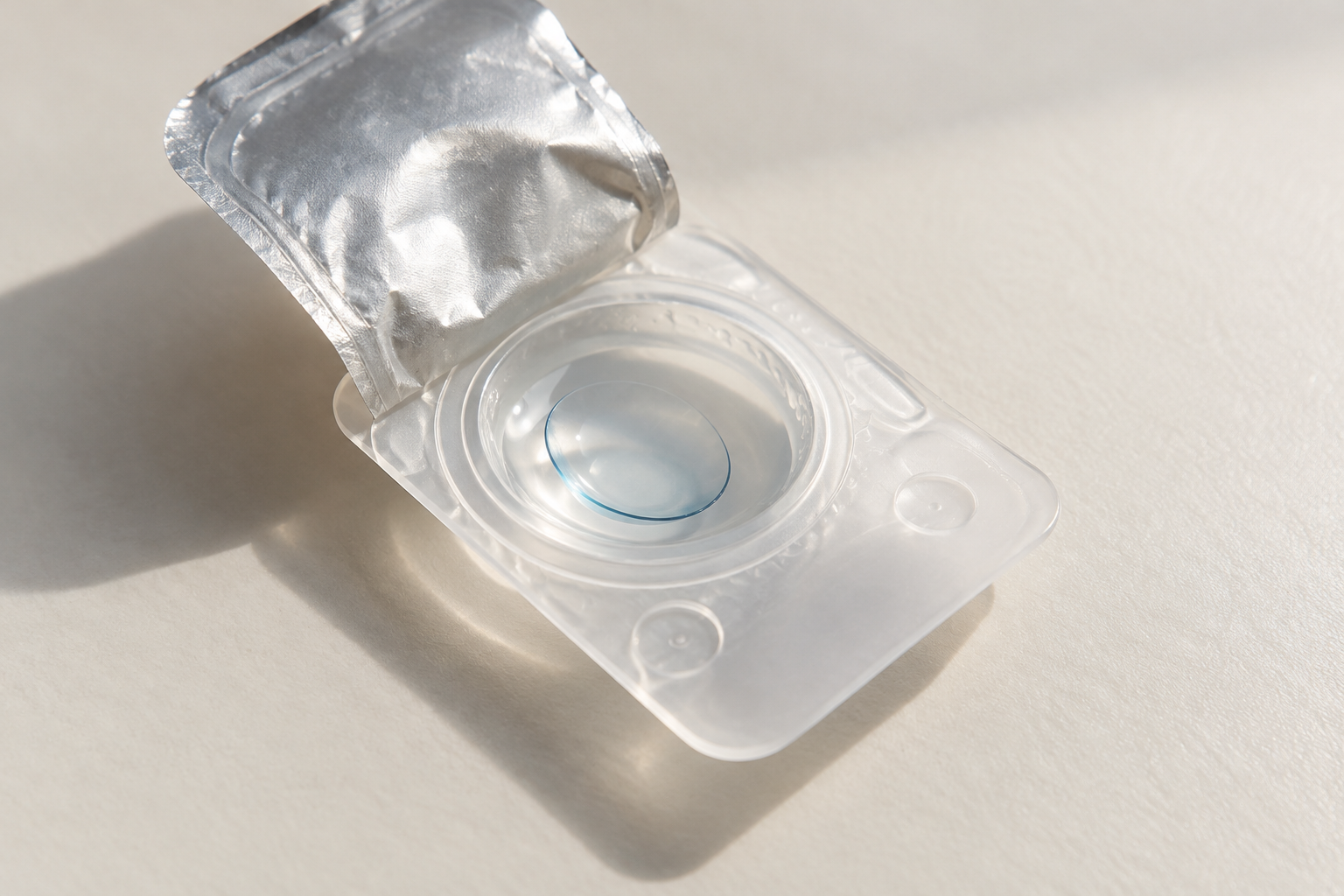
In the morning you peel back the foil and there is the lens, sitting in clear liquid. On your fingertip, that liquid cannot be told from water. If the factory is simply storing a lens, clean water would be the simplest choice, so why go to the trouble of using something else?
Soft lenses can change in size and shape with the salt level and acidity of the liquid around them, so the liquid in the package is made as a buffered saline with its salt level and acidity adjusted.
The difference between solutions for cleaning and disinfecting lenses is covered in Why Is Contact-Lens Solution More Than Salt Water?, and the reason packages carry a date in Why Do Unopened Contact Lenses Have an Expiration Date?. This time we look only at what the liquid in the package is made of and what each ingredient does.
The name in the instructions is buffered saline
Johnson & Johnson's daily lens instructions state that each lens is supplied in borate-buffered saline with methyl ether cellulose added. Split the long name and there are three parts. Saline is the salt, borate buffering is the mechanism that holds acidity steady, and the cellulose-type ingredient is an additive on top.
Not every product has the same make-up. A 2010 master's thesis from the University of Waterloo sums up that earlier packaging fluids were saline alone, and that several companies then began adding surfactant and wetting ingredients. The starting point is salt water, with product-specific adjustments added on top.
Plain water unsettles the shape of a soft lens
In its guidance on water and lenses, the US Centers for Disease Control and Prevention (CDC) explains that water can change the shape of soft lenses, make them swell and make them stick to the eye. It also warns that most water is not sterile.
A change in size also means moving away from the numbers on the box. Base curve and diameter are values that describe a lens's shape, so if a lens swells it is hard to assume those values stay the same. The packaging fluid therefore does more than keep a lens wet; it sets the environment the lens sits in.

Salt is needed because of osmosis
Osmosis is water moving through a membrane towards the side with more dissolved particles. StatPearls material in the US National Library of Medicine's Bookshelf explains that the net movement of water is towards the side with the higher solute concentration. This is why the concentration of the surrounding liquid can affect a lens.
The thesis mentioned above also observes that materials react differently. It says that when one material (etafilcon A) was placed in a solution low in salt, liquid entered the material and its diameter increased by 20%. Three other materials, by contrast, showed no great change in specification. This is an observation by the author with no data shown, but it does show that “lenses” do not all react to liquid to the same degree.
So is packaging fluid exactly the same concentration as tears? Not necessarily. The thesis measured packaging fluids from around 2010 and found a wide spread between products, from values close to tears to fairly high ones. The author thought the high values for some lenses might serve to maintain their specifications, but wrote that the reason for other materials was unknown. The author added that a high value does not necessarily mean discomfort. These measurements are of products at that time, so they cannot be transferred directly to today's products.
Buffering ingredients hold acidity steady
The same thesis gives the pH of human tears as between 6.6 and 7.8. It says that liquid touching the eye outside this range can cause discomfort or stinging. The packaging fluids measured ranged from 7.01 to 7.57, all within that range.
Acidity is not only a question of how something feels. A 2023 experiment in Heliyon placed lenses in buffered saline from pH 6.2 to 8.2. With one material (etafilcon A), as pH fell, water content and diameter decreased and power moved further in the minus direction. Another material (hilafilcon B) barely changed.
This means acidity can affect lens specifications depending on the material. From this we can guess why a buffering ingredient, which keeps acidity from shifting easily, goes in along with the salt.
The last ingredient aims at how first wear feels
The thesis gives three purposes for modifying packaging fluid: stopping lenses sticking to the package, helping the lens surface wet well and aiding comfort at first wear. That a lens floats in liquid rather than clinging to the bottom when you peel back the foil reflects this kind of thinking.
It is hard, however, to be definite about the effects. The thesis wrote that little published information exists about such additives. Because reusable lenses go into storage solution after the first day and the packaging fluid ingredients wash out, it expected them to matter more for daily lenses. Daily lenses go straight from packaging fluid to the eye every time they are worn.

The liquid in a sterile package
The symbol list in the instructions mentioned above includes one mark indicating sterilization by steam heat and another indicating a sterile barrier. There is also a note not to use the lens if the package is open or damaged. The liquid in the package is part of the product, prepared with the lens at the factory.
Looking at the liquid left on your fingertip
Packaging fluid is an environment adjusted to bring a lens as far as your eye. Using tap water in its place while handling lenses can bring both the changes described above and the problem of germs. If stinging or discomfort continues right after you put in a lens, it is best to remove the lens and check with an ophthalmologist or optometrist.
Next time you open a lens, look for the phrase “buffered saline” in the instructions or on the package. A single drop of clear liquid holds the calculations made to protect the size of the lens.