
Why Do Arctic Snow Goggles Have Only a Narrow Slit?
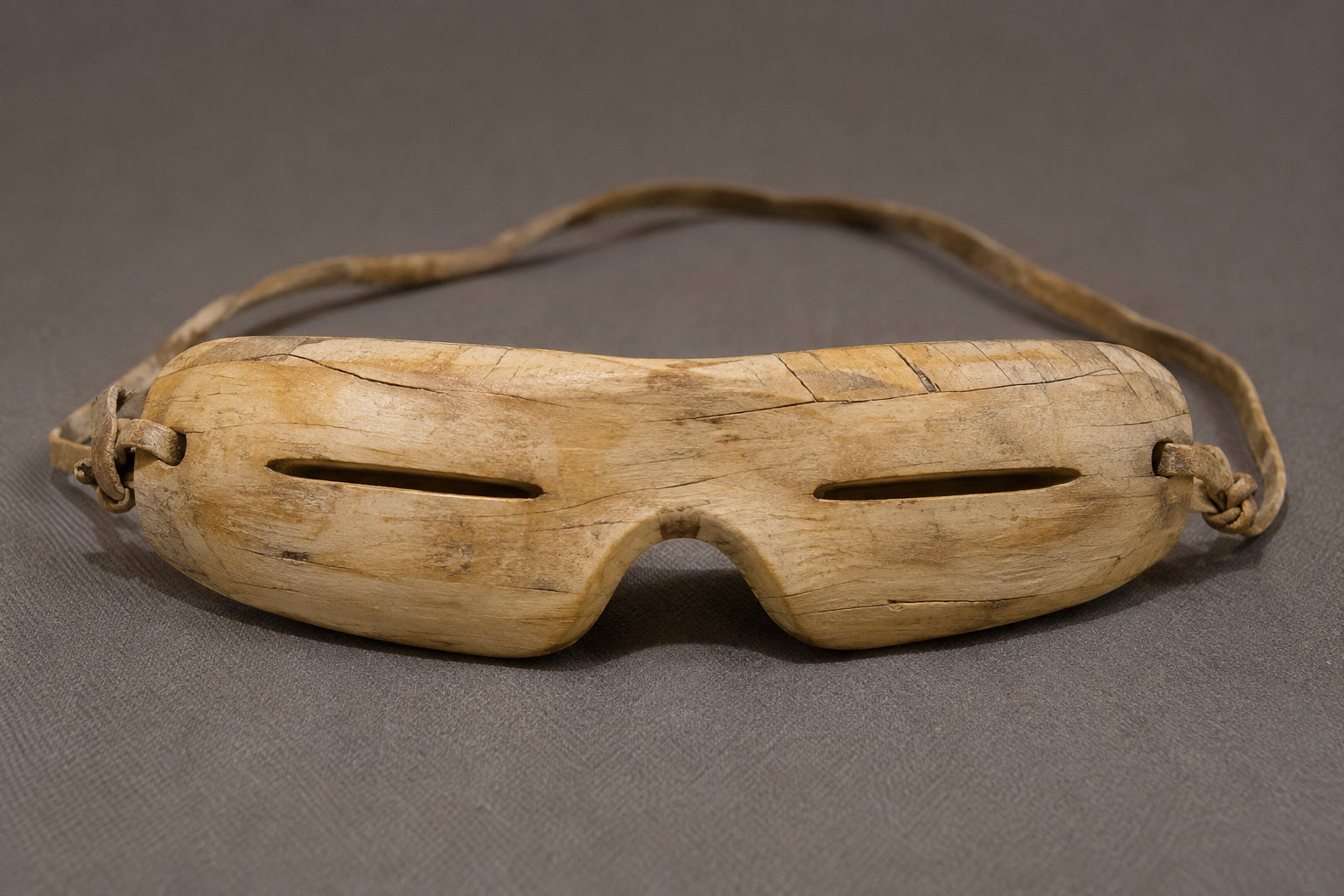
Step out onto a snow-covered playground on a bright, sunny day and it is hard to keep your eyes properly open. Without thinking, you put a hand to your forehead and narrow your eyes. Museums hold objects from the Arctic that look as if this very gesture had been turned into a thing: goggles carved from wood or ivory to fit the face, leaving only a thread-thin slit in front of the eyes. Why did these objects, without a single piece of glass, take this shape?
A narrow slit greatly reduces the light entering the eyes while still leaving a way to see ahead.
This article follows museum records and research to look at the materials and shapes of the goggles, the light that snowfields send back, and the principle contained in a single slit.
Goggles in a museum drawer
According to educational material from the Canadian Museum of History, the museum holds more than 100 pairs of Inuit snow goggles. The pair it presents is made of walrus ivory, comes from an old Inuit house site on Baffin Island, and is dated to AD 1000–1600. In the same material, Ross Kayotak, an artist from Igloolik, Nunavut, explains that this time the goggles are being carved from the rib of a bowhead whale.
Parks Canada's feature on an object in its collection shows wooden goggles from around 1850. In Inuktitut they are called iggaak, and it is not known who made them or where. The University of Pennsylvania Museum in the United States holds goggles carved from a single piece of wood and labelled with the name of the Point Barrow, Alaska, expedition (1899). One pair of oak goggles held by the Science Museum Group in the UK has a slit 92mm long but only 3mm high.
Snowfields send light back
The reason a narrow slit was needed lies underfoot. According to the World Health Organization (WHO)'s questions and answers on ultraviolet radiation, grass, soil and water reflect less than 10% of the UV that falls on them, but snow reflects as much as 80%. It also states that fresh snow almost doubles the amount of UV a person receives.
Mogens Norn, a physician at the Museum of Medical History of the University of Copenhagen in Denmark, described the experience of travelling towards a low sun in Greenland. One hand rises to the forehead of its own accord, but the light coming up from the sea, snow and ice is just as troublesome. So if you put the other hand below your eyes and leave a gap between the two palms, you can see clearly without glare. Blocking above and below at the same time is exactly what the slit in the goggles does.
Why dark lenses and UV protection are two different matters is covered in our article on sunglasses UV labels.

Snow blindness, a burn to the eye
According to the American Academy of Ophthalmology (AAO)'s explanation, photokeratitis is a painful eye condition caused by exposure to invisible light, and snow blindness is photokeratitis caused by UV reflected off ice and snow. Symptoms include pain, redness, blurred vision, a gritty feeling as if there were sand in the eye, and sensitivity to light.
The tricky part is the delay. The academy explains that people often notice the symptoms only well after the damage has been done. The symptoms usually fade gradually over a day or two.
Norn reported that the district doctor in Tasiilaq, East Greenland, treated about 20 patients with snow blindness each year, and added that because the condition is well known, many people do not go to the doctor, so the real number is probably much higher. If you have eye pain or a change in vision, it is best to check with an ophthalmologist or optometrist.
One slit cuts the light to 2–8%
Norn took out 59 pairs of goggles held in museums in Denmark and Greenland, measured and drew each one, and in 1996 set out the findings in a paper in the Greenland research journal Meddelelser om Grønland. Most were carved from wood, and a few pairs were made of musk ox horn, reindeer antler, walrus tusk, bone or sealskin.
The slits fell into eleven types, from short rectangles and long slits joining both eyes to figure-of-eight, teardrop and triangular shapes. Calculating the light reaching the eye from the ratio between the field visible through the slit and the natural field of view, Norn concluded that the goggles reduce harmful light to 2–8%. The three types of rectangular slit gave 2–3%, and even the most generous round holes only about 8%.
At least 17 pairs had their inner surface, on the eye side, blackened with soot. Norn considered that this black surface further prevented harmful light from seeping in.
When a narrow slit makes things look sharper
The goggles have no corrective lenses, but Norn believed the slit also had an optical role. It works on the same principle as the black test card with small holes or slits used to gauge visual acuity roughly. A narrow slit filters out spreading light, so the image blurs less even in an eye that is slightly out of focus.
In Norn's model experiment, a person with -2.00 myopia saw visual acuity rise from 0.25 to 0.33 when looking through a slit 3mm high. Facing the sun, acuity of 0.1 became 0.33 through a 2mm slit, an improvement of about three times. Parks Canada's feature also notes that the goggles narrow the field of view but make what can be seen clearer.
However, this was a simple experiment with a small number of people and a model. It should be read not as meaning that the slit corrects vision, but as a result showing the principle that a narrow slit reduces image blur.

The price: the view above and below
The narrow slit comes at a price. By Norn's calculation, the vertical field of view of an eye wearing the goggles averaged 10.5 degrees, far short of the roughly 120 degrees of the naked eye. Walking while actually wearing old goggles was fine on flat ground, Norn reported, but on uneven ground the body swayed and there was a risk of tripping over obstacles. Not being able to see well underfoot was the biggest weakness.
There were also five pairs of goggles with dark glass fitted into round holes instead of slits. Norn took them to be imitations of European sunglasses; they gave a wider field of view but fogged up and froze easily in the cold. In an experiment in which they were put in a refrigerator and taken out again, glass spectacles quickly clouded over, while the goggles with only slits did not fog at all. Why glasses fog up can be found in our article on glasses fogging up in winter.
An old way of letting less light in
In Norn's words, what can be seen through the goggles is a compromise between seeing and protecting. Materials and shapes differed by region and by maker, but the idea of blocking above and below and leaving a thin slit survives in the collections of many museums alike.
The images in this article are generated images to aid understanding, not actual archival photographs or photographs of collection objects.
Next time you stand on a snowfield or by water that reflects sunlight, cover above and below your eyes with your palms to make a horizontal slit. Compare how comfortable your eyes feel before and after, and you will quickly sense the principle behind these goggles.