
Why Is the PD for Glasses Written Separately From the Power?
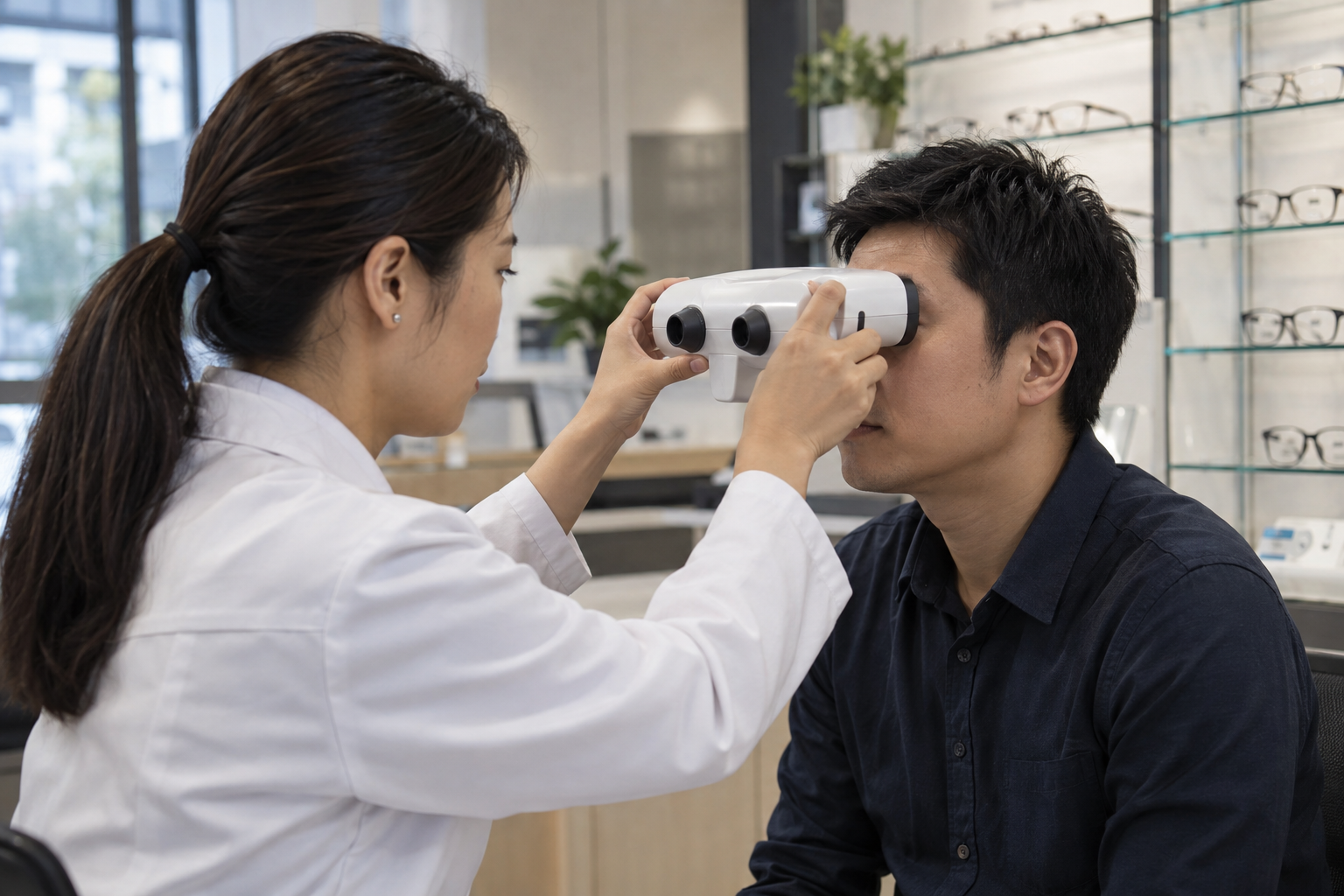
You dig out the record you were given when you had glasses made some time ago. Below the powers for the right and left eyes, a separate figure, PD 62, is written without any unit. Since it sits alongside the numbers for nearsightedness or astigmatism, is it another power showing how weak your eyes are?
PD is not a power but the distance between the centres of your two pupils: positional information that decides where on your face the centres of your spectacle lenses should go.
If the power decides the strength of the lens, PD decides where that lens is placed. This article looks only at the principle of what happens inside a lens when that position is off. It does not cover how to measure or calculate it yourself.
Strength and position are different information
ZEISS's explanation of individual measurements defines PD, or pupillary distance, as the distance in millimetres between the centres of the pupils of the right and left eyes. Two people with the same prescribed power need not have the same distance as well.
The reason this distance is needed lies in the centre of the lens. Mo Jalie's article on lens form, published by the UK opticians' association ABDO, explains that when the optical axis of the lens coincides with the eye's line of sight, the eye looks through the optical centre of the lens and the image is not disturbed. It also states that if no prism has been prescribed for distance glasses, the optical centre of the lens sits on the line passing through the centre of the pupil.
Why prescriptions for glasses and contact lenses are written differently is covered in our article on the difference between the two prescriptions.
Away from the centre, a lens becomes a prism
Away from its optical centre, a lens with power acts like a prism that bends light to one side. A 2016 paper by researchers at the Cape Peninsula University of Technology in South Africa explains that the size of the resulting prism effect is determined by the power of the lens and by the distance between the optical centre and the line of sight, and that it is calculated using Prentice's rule.
An example in Jalie's article gives a feel for it. In a +4.00 lens, the prism effect at a point 10 mm from the centre is 4 prism dioptres, and at 15 mm it is 6 prism dioptres. When the distance became 1.5 times greater, so did the effect. Because the power and the distance off-centre decide the size together, a weak lens and a strong lens can give different results for the same misalignment.

Each eye's position can be considered separately
PD is sometimes written as a single number, but there is also monocular PD, written separately for the right and left eyes. The 2016 paper mentioned above notes that pupil distances measured one eye at a time are often asymmetrical between left and right. This is why mechanically halving the total can leave the centres of the two lenses slightly out of line with where the pupils actually are.
That your two eyes are not copies of each other is also discussed in Why Do Your Right and Left Contact Lenses Have Different Powers?.
Position is not set horizontally alone. The ZEISS explanation of measurements notes that the points where the left and right eyes look through the lenses also differ from each other, and that these points are measured from the lower rim of the frame. In effect, the centre of the lens finds its place in two directions, horizontal and vertical.
More sensitive to vertical than horizontal misalignment
How much can be tolerated also depends on the direction of the misalignment. Citing the results of another research group (du Toit and colleagues), the same paper sums up that wearers tolerate horizontal prism relatively comfortably up to 1.0 prism dioptre, but vertical prism only up to 0.5. This is why more attention is paid to vertical misalignment, which arises when the centres of the two lenses are at different heights.
The paper explains that unintended prism can disrupt the ability of the two eyes to work together, which can lead to eye strain, headaches, blurred vision and double vision. However, discomfort with new glasses can have several causes, such as the prescription, how the glasses were made or how the frame sits, so if the discomfort continues, it is best to check with an ophthalmologist or optometrist.
Measuring reading glasses made to a fixed distance
When you read a book, your eyes turn inwards. So this paper looked separately at pupillary distance for near vision. Records of 1,080 people aged 40 and over, gathered at an optometry practice in Cape Town, gave averages of about 59 mm and 62 mm (for the female and male groups), while the narrowest and widest values were 51 mm and 71 mm, a full 20 mm apart. This is the result of a study in one area only, not a reference value that fits everyone.
The researchers also examined ready-made reading glasses. The paper describes these as mass-produced glasses with the same power for both eyes and a fixed distance between the lens centres. When 60 pairs were measured, the average distance between lens centres was wider than the average for the wearer groups. Horizontal prism mostly fell within international standards, but vertical prism exceeded them in 10% of the products classed as women's and in about 37% of those classed as men's. It is an example of how hard it is to fit a distance that differs from person to person with a single fixed value.

Positions measured besides PD
PD is not the only number that sets position. ZEISS's explanation of individualized lenses says that when individualized lenses are made, the distance between the back of the lens and the front of the cornea, the tilt of the frame, the curve of the frame and the height at which the wearer looks through the lens in the chosen frame are all checked.
Since the same frame sits differently on different faces, these values only mean something with the frame being worn. The explanation also treats individualized and standard lenses separately because different lens designs need different information. Knowing your PD alone does not fill in all the positional information for every lens.
Next time you stand in front of a mirror
PD is not a number that measures the strength of your eyes but positional information for bringing the centre of each lens in front of the pupil. Away from its centre, a lens bends light like a weak prism, and how much is decided by the power and the distance off-centre together.
Next time you stand in front of a mirror wearing your glasses, look straight ahead and notice roughly where your pupils fall on the lenses. Why a separate number for distance always travels alongside the numbers for power will feel a little closer to home.