
How Are Contact Lenses Made?
A soft lens resting on your fingertip is as thin as paper and as soft as jelly. It is remarkable, when you think about it, that something so floppy holds an exact power and curve. So how on earth are lenses made?
There are three main ways to make contact lenses: cutting a solid block, spinning a liquid in a mould, or putting a liquid between two moulds and letting it set.
This article follows the principle behind each method and how each one came about. Lens prices are covered separately in Why Are Contact Lenses So Expensive?
Method one: cutting
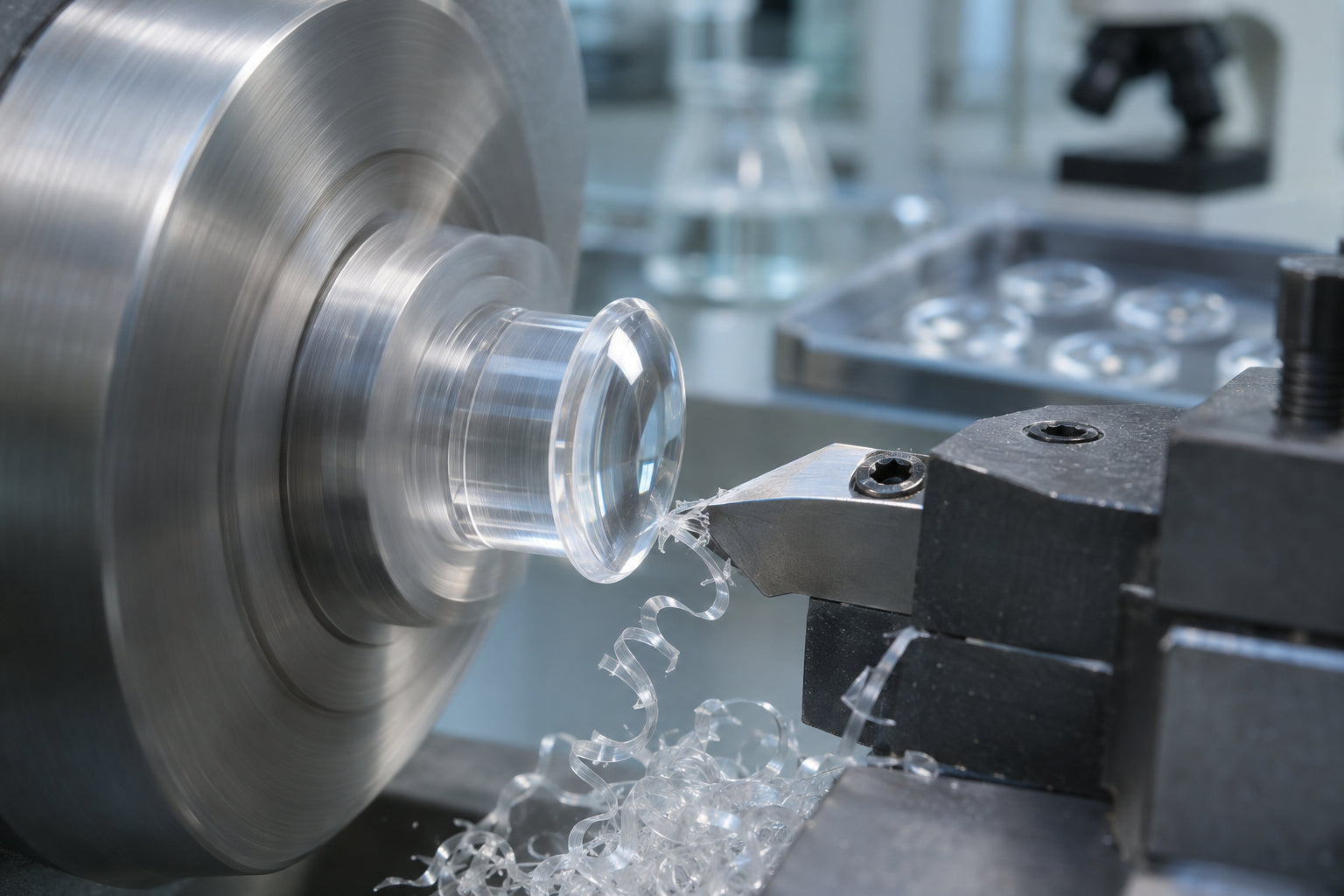
First, lathe cutting. The material spins at speed while a blade is held against it to cut away the desired curve. The Science Museum Group in the UK holds a turret lathe from around 1950, recorded as having been used to cut the back and front surfaces of large scleral lenses, which cover even the white of the eye. It came from the contact lens department of Moorfields Eye Hospital.
The same collection also includes a lathe for lens front surfaces, made in London between 1965 and 1969. There was, in other words, a dedicated machine just for cutting front surfaces.
This method has not disappeared. A review of materials published in 2019 in the journal Materials explains that lens material can be made into small cylindrical blocks, known as “buttons”, which are then cut on a lathe to finish the lens. It also notes that ultra-precision lathes are used today to make speciality lenses, handling surfaces at the nanometre scale.
The problem of a material that holds water
In the 1950s, the Czechoslovak chemists Otto Wichterle and Drahoslav Lím set out to make lenses from a gel that holds water. Even once they had the material, how to form it into the shape of a lens remained a problem. According to a paper by Marcela Efmertová of the Czech Technical University, published in 2024 in the journal Acta Polytechnica, research into making gel lenses by pouring them into moulds did not go well at first, and in 1958 the university halted this research.
In 1959 Wichterle founded the Institute of Macromolecular Chemistry of the Czechoslovak Academy of Sciences and became its first director. The institute's 60th-anniversary article remembers Wichterle above all as the inventor of the centrifugal casting method for producing soft lenses.

A construction toy at Christmas
Efmertová's paper places the turning point at Christmas 1961. Wichterle built an apparatus from Merkur, the construction toy belonging to the two Wichterle sons, ran it on a power supply meant for a bicycle lamp, and tested a method of spinning lenses as they set. The power supply was later replaced by a stronger gramophone motor, and a patent application was filed right after the tests.
The first lens was made from a mixture of 80% of a component called hydroxyethyl methacrylate (HEMA) and 20% of another component. The paper's abstract describes the apparatus as a home-built experimental setup, and also mentions the home-made glass tubes and moulds.
Spinning speed makes the curve
The principle of spin casting resembles the way the middle of the water dips into a hollow when you swirl water round in a cup. As the paper explains, when liquid material is poured into a small dish connected to a rotating device and spun, the surface of the liquid becomes concave. How concave it became could be controlled through the rotation speed, the size of the dish and the viscosity of the material, and once the material had set, the finished lens was taken out. Wichterle concentrated on keeping costs to a minimum with this method of spinning open moulds without lids.
By mid-1962 the basic parts of the lens-making machine had been built, and by 1963 the production method was nearly complete. Interest from foreign businesspeople then grew, and on 12 March 1965 a licence agreement was signed in Prague with an American company.
Later, Bausch + Lomb records in its company timeline that in 1971 it launched SofLens as the first mass-produced soft lens in the United States. The Science Museum Group in the UK holds two SofLens lenses from 1981 donated by Bausch + Lomb, and the record describes them as “spin-cast lenses”.
Setting between two moulds
The third method is cast moulding. As with a waffle iron, two halves of a mould, one upper and one lower, are fitted together, and the space between them is filled with liquid material, which then sets. Both the front and back surfaces of the lens follow the shape of the mould exactly.
One of the patents covering this method is Thomas H. Shepherd's US Patent 4,121,896. It was filed in March 1976 and granted in October 1978. The patent makes the convex and concave moulds from a thermoplastic such as polypropylene, and lets a thin rim bend to follow the material as it shrinks while setting. That rim also forms the edge of the lens.
The interesting part is where the cutting and polishing went. The patent explains that a master metal mould, cut and polished, is placed in an injection or compression moulding machine to turn out many plastic moulds. Because precision machining and polishing are done only on the master metal mould, it says, there are great savings compared with cutting and polishing lenses one by one. The patent also said the plastic moulds could be reused if handled carefully, and noted that the lens edges still had to be cleaned and finished.

The mainstream in lens factories today
What about today? The outline can be seen in the filings of one large lens company. The Cooper Companies, which owns CooperVision, wrote in its annual report for fiscal year 2022 that it uses several manufacturing processes but makes lenses mainly by cast moulding. This covers everything from high to low volumes, including custom lenses for high astigmatism.
That does not mean one method pushed the others out at a stroke. The Science Museum Group in the UK holds a set of objects made in 1984 by one lens company (Hydron Europe): samples showing the stages of cutting and polishing soft lenses, lens buttons, and polypropylene moulds used for cast moulding. They show cutting and moulding being used side by side within a single company.
How the habit of replacing lenses frequently took hold continues in our article on the habit of throwing away a fresh lens every day.
Traces of method in a single lens
Cutting shapes each lens individually and is still used for speciality lenses today; spinning opened the way for soft lenses with a simple apparatus; and moulding put the precision into the mould so that the same lens could be made over and over again. Which method is used depends on the type of lens and the quantity being made.
Next time you rest a lens on your fingertip, take a look at its edge. That thin rim may have been cut with a blade, or it may have formed where two moulds met. Even in the small curve on your fingertip, the process the lens went through has left its mark.