
What Does 52□18 140 on the Arm of Your Glasses Mean?
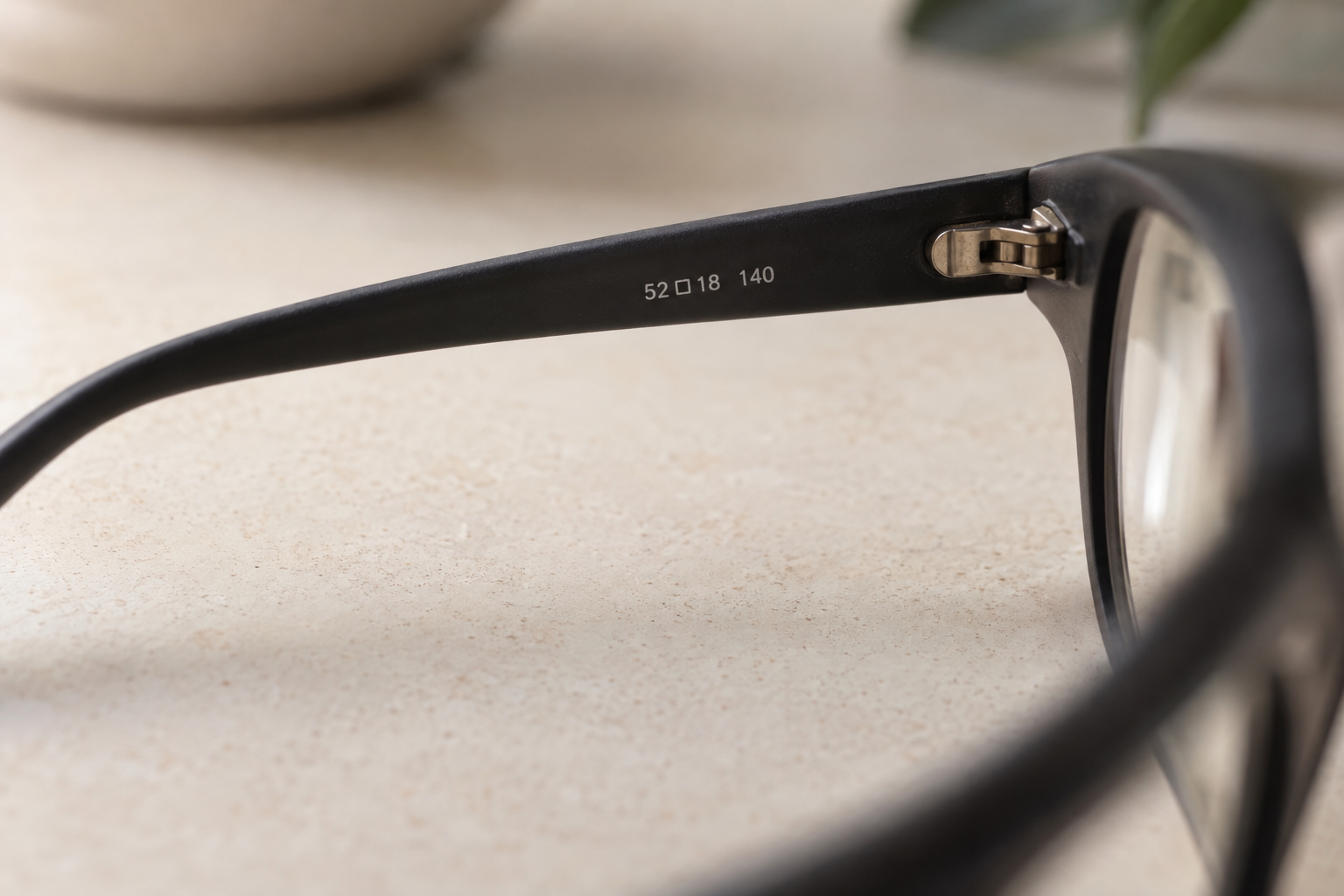
You are cleaning your glasses when some small print on the inside of the arm catches your eye. Next to the model name and colour number: 52□18 140. Not S or M, as on clothes, but three numbers side by side, with no unit given. What exactly do these numbers measure?
The three numbers give the width of one lens, the distance between the two lenses and the length of the arm, in millimetres: the three measurements the international standard for spectacle frames names as the most important.
This article looks in turn at where each number is measured from and to, and at what the numbers alone cannot tell you.
The lens is measured inside a box
Spectacle lenses come in all sorts of shapes: round, square, teardrop. To measure differently shaped lenses on the same basis, the international standard ISO 8624 uses the “boxed lens system”. In the table of contents of ISO 8624:2020 published by the German standards body DIN, the entry for this system's key terms lists the three most important measurements of a frame as the horizontal lens size, the distance between lenses and the overall length of the arm.
The name “box” comes from drawing an imaginary rectangle around the lens. Lecture notes on ophthalmic optics from Al-Mustaqbal University in Iraq explain that the box is drawn so that its four sides touch the outermost edges of the lens shape. The first number, 52, is the width of this box, that is, the width of a single lens. It is not the width of the whole pair of glasses.
18 is not nose height but the gap between two boxes
The middle number, 18, is the distance between lenses. The same lecture notes describe it as the shortest distance between the nasal edges of the two lenses, or the gap between the two boxes, and add that it is commonly called the bridge size. It is not a grade for how high or low a nose is, but a gap measured on the frame.
The notes also explain that the distance between the centres of the two boxes is sometimes called the “frame PD”. The name is similar to PD, which means the distance between the pupils, but this value is measured on the frame, not on a person's face.
Nor is there only one symbol between the numbers. As an example of how a frame can be marked, the lecture notes give a form with a dash, such as 54-18. Whether a square or a dash is printed, the first two numbers still refer to the lens width and the distance between lenses.

Same width, different height
A box has more than a width. The lecture notes give a separate name, the “B measurement”, to the distance between the top and bottom of the lens shape, that is, the height of the box. Even with the same width of 52, a flat rectangular lens and a round lens can have very different B measurements.
Yet the three numbers inside the arm do not include this height. In ISO 12870, the international standard for spectacle frames published in 2004, the items given tolerances for marked dimensions were likewise the horizontal lens size, the distance between lenses, the bridge width and the overall length of the arm. Height was not among them.
There are cases where lens height matters. ZEISS's explanation of individualized lenses states that when individualized lenses are made, the frame dimensions and the height and width of the lenses are measured precisely, and it is also checked at exactly what height the wearer looks through the lens in the chosen frame. It is hard to guess the height of a lens from the width figure alone.
140 is measured with the arm straightened
The last number, 140, is the length of the arm. ISO 12870 (2004 edition) set out that, to measure this overall length, the part that bends down behind the ear is straightened, and the distance is measured in a straight line from the hinge screw to the tip of the arm. The slight curve that follows the shape of the head is straightened too.
So two pairs of glasses with the same 140 can still differ in where the arm starts to bend and how it wraps around the side of the head. How the present shape, with arms that hook over the ears, came to be established is covered in Did Glasses Always Have Temple Arms?.
The marked numbers have a tolerance too
The numbers inside the arm are not a promise accurate to 0.1 mm. ISO 12870 (2004 edition) allowed the difference between the marked and actual dimensions, when measured with a ruler more precise than 0.1 mm, to be up to ±0.5 mm for the lens width, the distance between lenses and the bridge width, and up to ±2.0 mm for the overall length of the arm. Under that edition, the lens width of a frame marked 52 could fall anywhere between 51.5 mm and 52.5 mm. The standard has since been revised several times, with editions including those of 2012 and 2016, so the figures in the latest edition may differ.
Countries also adopted the standards at different times. A comparative study published in 2009 in the Journal of Korean Ophthalmic Optics Society set the frame standards of Korea, Japan, Germany and the United States alongside the international standard, and summed up that the Korean and American standards also measure using the box method. It pointed out, however, that the Korean Industrial Standards (KS) were slow to reflect revisions to the international standard, leaving a time lag. A table in the same paper lists DIN 58200 of April 1961 as an earlier edition of Germany's standard for measuring frames.

What the numbers do not tell you
The three numbers are values measured with the frame lying on a table. Once it sits on a face, other variables come in. ZEISS's explanation of individual measurements says that because every face is different, the degree to which the front of the glasses tilts also differs, and it deals separately with the distance between lens and eye and with how much the frame curves to wrap around the face.
A frame with separate nose pads and a frame where the part resting on the nose is part of the frame itself sit on the nose differently, even with the same 18. Whether the lower rim touches your cheeks when you smile, or whether the glasses slide down when you tilt your head forward, can only be seen on the face. If the glasses keep feeling uncomfortable, it is safer to have them checked by an optician or optometrist than to bend the arms at home.
Next time you clean your glasses
52□18 140 is not a chart that assigns your face a size, but three lengths measured with each lens placed in a box. It tells you the lens width, the gap between the lenses and the arm length, but not the height of the lens or how the frame sits on your face.
Next time you clean your glasses, picture a box around the lens with all four sides just touching it. You will see at a glance that the width of that box is the first number inside the arm.